Welcome to the world of Ilario. The official Ilario Modelcars website
Henri Chapron
The Art of Transformation
COACHBUILDER
Ilario CHIERA
8/12/20265 min read


Henri Chapron
The Art of Transformation
1. The Apprentice
Henri Chapron was born in 1886 in the heart of Sologne, a region of forests, quiet roads and timeless traditions.
From a very young age, he was drawn to the world of craftsmanship to wood, leather, metal, and the shaping of beautiful things.
He became an apprentice coachbuilder, learning the demanding art of carrosserie through patience, observation and long hours at the workbench.
Like many craftsmen of his generation, Chapron travelled across France as a compagnon, moving from workshop to workshop, absorbing knowledge, refining his skills, and discovering different approaches to design and construction. His journey even took him as far as Algeria.
He was not yet the master.
But the foundations were being laid: discipline, precision, and an instinct for elegance that would one day define his creations.


2. The Golden Age
The 1930s marked the flowering of Chapron’s talent.
As French luxury manufacturers produced increasingly sophisticated chassis, the great coachbuilders were given almost complete freedom to shape their bodies. Chapron embraced this new era with a distinctive vision: elegant proportions, flowing lines and a remarkable attention to detail.
During this period, his workshops worked on some of the finest French chassis of the time, including Delage, Delahaye, Bugatti, Voisin, Hispano-Suiza and Talbot.
Chapron’s relationship with Delage became particularly important. His designs for the D6 and D8 chassis combined long, graceful proportions with a sporting character, while carefully concealing the underlying chassis beneath the bodywork.
Then came the Delahaye 135.
Introduced in the mid-1930s, it became one of the great foundations of Chapron’s work. His atelier produced elegant open and closed bodies for these chassis, establishing a style that was unmistakably his own.
This was the golden age of French coachbuilding, a time when an automobile was not simply manufactured, but composed.
And for Chapron, every new chassis was an invitation to create something unique.


3. Delahaye
Delahaye chassis offered Chapron the perfect canvas.
From the powerful 135 to the rarer 165 and 175, Chapron created bodies of exceptional elegance, each one tailored to the character of the car and the wishes of its owner.
Long, low and harmonious, his Delahaye creations combined sportiness with refinement. Whether as a cabriolet, coach or coupé, every line was designed to express movement and grace, even at a standstill.
Many of these cars were unique commissions, ordered by discerning clients who sought both performance and distinction.
With Delahaye, Chapron reached the height of his art.


4. When the World Changed
After the Second World War, the world of coachbuilding was no longer the same.
The great custom-built automobiles of the pre-war years were becoming increasingly rare, as manufacturers turned toward mass production and standardized bodies.
Chapron, however, adapted rather than disappeared.
The company continued to create elegant one-off and limited-production bodies, while gradually moving closer to the major manufacturers.
This new era would eventually lead Chapron toward one of its most important chapters, its transformation of the revolutionary Citroën DS into some of the most celebrated French automobiles of the post-war period.
The world had changed. Chapron changed with it.


5. The DS
In 1955, Citroën unveiled the DS, a car unlike anything the world had seen before. Its aerodynamic form, advanced technology and almost futuristic proportions marked a new chapter in French automotive design.
For Chapron, the DS offered a remarkable new canvas. Henri Chapron saw beyond the practicality of the original saloon and imagined something more exclusive: elegant convertibles, refined coupés and special-bodied versions created for clients who wanted something truly different.
The most famous of these was the DS Cabriolet, first presented by Chapron in 1958 and later developed into the official production convertible offered through the Citroën dealer network. With its shortened rear section, carefully reworked bodywork and exceptional finish, it transformed the avant-garde DS into one of the most elegant French convertibles of its era.
Chapron's work on the DS was more than a change of body style. It was a meeting between Citroën's vision of the future and Chapron's traditional art of coachbuilding technology and craftsmanship, innovation and elegance.
For Chapron, the DS became not simply another automobile, but a new expression of the art of transformation.


6. Beyond the DS
The success of the DS Cabriolet established Chapron as one of the last great French coachbuilders, but the story did not end there.
The company continued to explore new forms and new possibilities, creating special-bodied automobiles for private clients and working closely with Citroën on increasingly exclusive versions of its cars. Chapron's creations combined the comfort and technology of modern automobiles with the individuality of traditional coachbuilding.
Among them were elegant coupés, convertibles and presidential cars, each carrying the unmistakable touch of Henri Chapron. The work became increasingly rare, but perhaps all the more precious for it.
As the great age of independent coachbuilding gradually disappeared, Chapron remained faithful to the idea that an automobile could be more than a means of transportation.
It could be a personal creation designed for one owner, shaped by one vision, and built to endure.
7. The Last Coachbuilder
By the 1970s, the great age of French coachbuilding was drawing to a close. Industrial production, changing tastes and increasingly complex regulations made the creation of individually bodied automobiles ever more difficult.
Henri Chapron nevertheless continued his work, remaining one of the last names to carry the tradition of the French coachbuilder into the modern era. His collaboration with Citroën had already produced the celebrated DS Cabriolet, as well as special versions of the SM and presidential automobiles.
What made Chapron remarkable was not simply the beauty of his cars, but his ability to adapt. He took radically modern automobiles and gave them the individuality, elegance and craftsmanship that had defined the great coachbuilding houses of an earlier generation.
In doing so, Henri Chapron became more than a coachbuilder. He became one of the final guardians of a disappearing art.
And when that era finally came to an end, the automobiles he had created remained as lasting examples of a time when a car could still be transformed into something truly personal.
About the illustrations
All illustrations in this article were created with the assistance of AI specifically for Ilario. Each is an original visual interpretation inspired by the historical record. They are intended to illustrate the story, not to represent historical photographs.
Selected Ilario Chapron Models


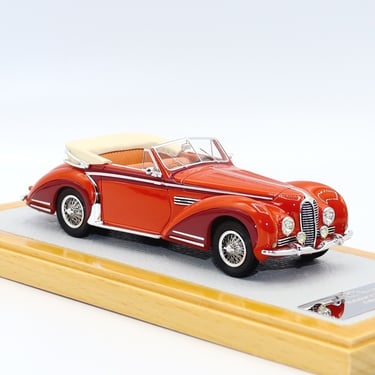
At Ilario, every Chapron miniature is more than a faithful scale model.
It is a tribute to an era when automobiles were individually imagined, shaped by hand and brought to life by some of the greatest coachbuilders the world has ever known.
Explore Related Stories
More to come
MANUFACTURER
COACHBUILDER
ILARIO MODELS
ATTENTION: Ilario models are not toys.
They are handcraft models, created and assembled by hand, using many small resin, white metal, photo-etched and turned parts.
They are intended for adult collectors passionate about automotive history and are not suitable for children under 14.
_______________________________________________
All trademarks, brand names, service marks and logos are the property of their respective owners, and are used for informational purposes only.
The logos and marks visible on the models are not advertisements.
They have been reproduced only to respect historical truth.
FOLLOW ME
Carbone 43
CHIERA Ilario
3 Impasse Les Trembles
74330 La Balme de Sillingy
FRANCE
SIREN: 33041256000030
EEC VAT N°: FR27330412560
EORI: FR33041256000030
EDEM: FR415784_01OTJI
DE LUCID N°: 3322876430474
©1984-2026 Carbone 43 All rights reserved
STAY CONNECTED
Receive occasional updates about new releases and exclusive editions.
EXPLORE
CUSTOMER CARE


Top